Advisory · May 2026
Business Automation Advisor: When You Need Strategy Before More Tools
A business automation advisor should help you do more than connect tools. The real value is understanding where automation fits, what should be improved before it is automated, and which opportunities are worth prioritizing.

Most businesses do not need more automation ideas first.
They need clearer judgment about which ideas are worth doing.
That is usually the point where a business automation advisor becomes useful.
Not because the team cannot connect apps.
Because the harder questions are usually upstream of the tools:
- what should be automated first
- what should be fixed before it is automated
- what should stay human-led
- where the real bottleneck is
- how to avoid building faster confusion
A business automation advisor should help with those decisions.
That is the real value.
What a business automation advisor actually does
The phrase can mean different things in the market.
Sometimes it means a tool implementer.
Sometimes it means a consultant who maps processes, identifies opportunities, prioritizes the work, and helps guide implementation decisions.
The second version is usually the more useful one.
A good business automation advisor helps a company understand:
- where repeated manual work is costing time and reliability
- where handoffs are breaking down
- which workflows are stable enough to automate
- which automations are simple rules problems versus AI-assisted workflow problems
- what the likely business value is if the change works
That is not just technical work.
It is operational judgment.
When outside advice becomes useful
There are a few moments where outside automation advice becomes especially helpful.
1. The team has too many ideas and no clear order
This is common.
People can see ten things that are manual.
They can see six systems that do not talk properly.
They can see that the founder or operations lead is still carrying too much in their head.
What they usually cannot see clearly is where to start.
An advisor should help rank opportunities by:
- business impact
- implementation difficulty
- process readiness
- risk if the automation fails
That matters more than having a giant list of possible workflows.
2. The workflow is messy and nobody wants to admit how messy
This is another strong signal.
The process exists, but only in fragments:
- one part lives in the CRM
- one part lives in email
- one part lives in spreadsheets
- one part lives in someone's memory
At that stage, automation can help eventually, but not before the workflow is understood.
A good advisor should be willing to say, "This process needs clarifying before it needs automating."
That kind of honesty is part of the job.
3. The business keeps adding tools without reducing friction
If every new system promises efficiency but the work still feels slow, manual, or fragile, the problem is probably not just missing software.
It is likely one of these:
- unclear ownership
- weak handoffs
- disconnected systems
- too many exceptions
- no common view of the real workflow
That is where a business automation advisor can help separate tool problems from process problems.
4. The business wants to scale without adding matching headcount
This is one of the clearest drivers.
As volume grows, the same repeated tasks become more expensive:
- manual data entry
- internal routing
- follow-up coordination
- status updates
- approval handling
An advisor should help decide where automation creates real leverage and where it would simply multiply instability.
What a good advisor should look at first
The strongest automation advice usually starts with the workflow, not the platform.
That means looking at:
- where work enters the system
- who touches it
- where it waits
- where it gets reworked
- where information is copied or recreated
- where exceptions show up
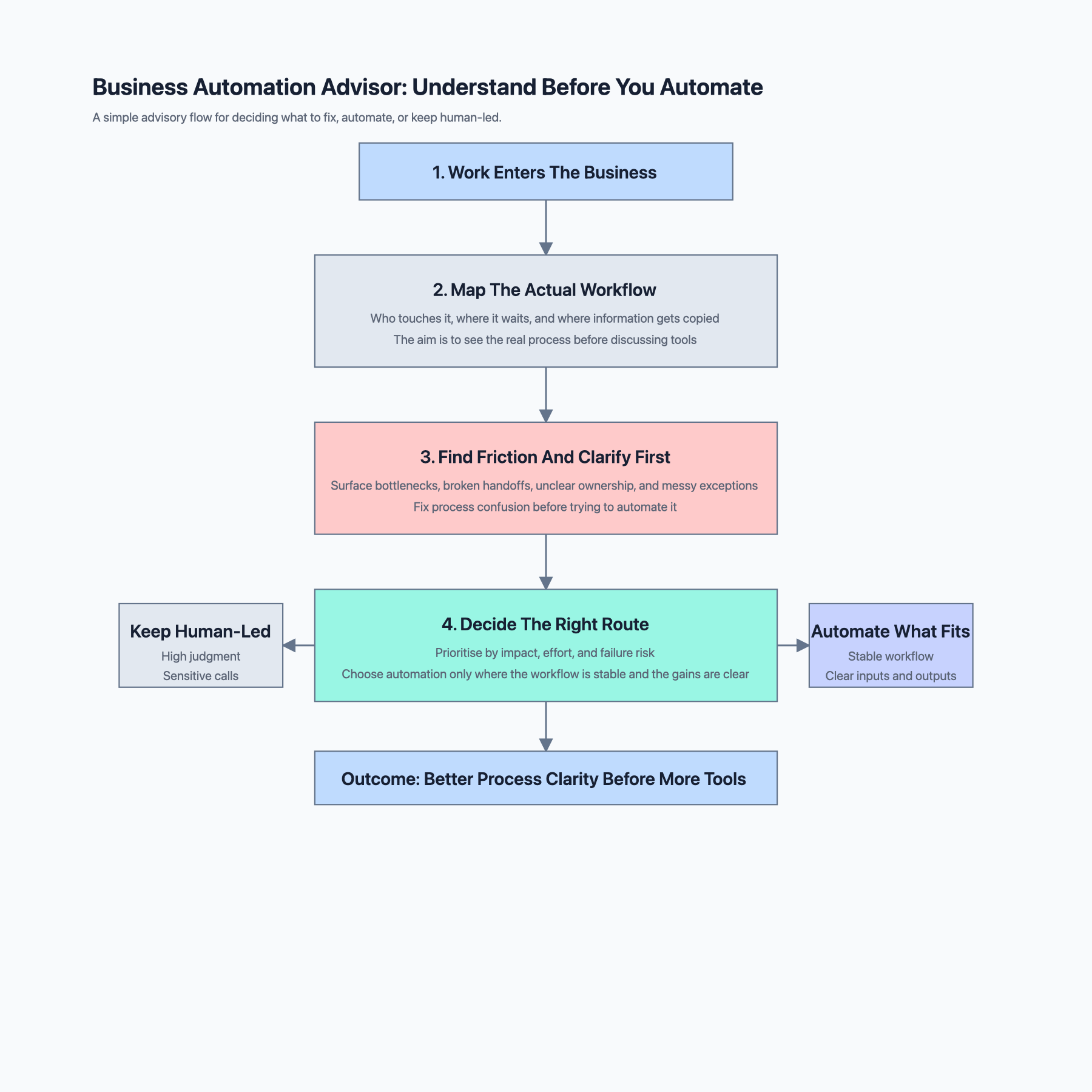
The right framing here is not just to automate isolated tasks, but to improve how the whole process works.
That is the right standard.
If the advisory work starts and ends with tool demos, the business is probably not getting enough value yet.
What a good advisor should help you decide
A useful business automation advisor should make a few decisions clearer.
What to automate now
Usually the best early targets are:
- repeated
- visible
- measurable
- low-risk to correct
What to improve before automating
Some processes are too inconsistent, too exception-heavy, or too poorly defined to automate well yet.
Those need redesign first.
What does not need AI
This matters more than many buyers expect.
Some workflows need simple rules-based automation.
Some need integration.
Some need AI for classification, summarization, or decision support.
A good advisor should know the difference and not force AI into places where it adds cost without adding value.
What should stay human-led
Sensitive approvals, pricing decisions, difficult customer conversations, compliance-heavy steps, and unstable processes often need strong human oversight.
Automation should support those workflows, not quietly take ownership of them.
What to watch out for
If you are evaluating a business automation advisor, a few warning signs are worth noticing.
Tool-first selling
If the answer arrives before the process is understood, be careful.
Promises that sound too certain
Guaranteed savings, universal ROI, or "we can automate everything" language usually hides a lack of nuance.
No interest in process mapping
If the advisor is not curious about how the work actually moves, they are likely solving the wrong layer.
No discussion of ownership
Automations need someone to own the workflow after launch.
If that is missing, trust usually decays quickly.
A practical way to evaluate fit
Before hiring a business automation advisor, ask a few direct questions:
1. How do you decide what should be automated first? 2. How do you tell when a process should be improved before it is automated? 3. How do you distinguish rules-based automation from AI-assisted automation? 4. What do you look for in a workflow before recommending implementation? 5. How do you think about ownership, monitoring, and process drift after launch?
The answers matter.
They will tell you whether the person is thinking like a tool implementer or like an operator.
Final thought
A business automation advisor should help you do more than connect software.
The real value is helping the business think clearly about where automation fits, where the bottleneck actually is, and what should happen before implementation begins.
That means better prioritization, better process clarity, and better judgment about when to automate, when to improve first, and when to keep people firmly in the loop.
If you are weighing a system decision, I’m happy to compare notes.